
Oil in 2025: Market Anticipation in the Second Half


The global oil market in 2025 has presented a complex landscape characterized by shifting supply-demand dynamics, evolving geopolitical tensions, and conflicting price pressures. The first half of the year established key trends that continue to influence market expectations as we progress through the second half, with significant implications for both short-term trading strategies and long-term investment positioning.
Oil performance in the first half of 2025
Mixed price dynamics and market volatility
Contrary to expectations of immediate price declines, the first quarter of 2025 actually witnessed upward pressure on Brent crude prices. However, this initial strength proved temporary as fundamental oversupply concerns began to dominate market sentiment. By July, Brent crude had settled around $71 per barrel, setting the stage for further declines as analysts projected prices falling to $58 per barrel in the fourth quarter of 2025.
The oil market demonstrated characteristic volatility throughout the first half, with geopolitical events providing temporary price support before fundamental supply-demand imbalances reasserted downward pressure. These short-lived spikes, including reactions to regional tensions and supply disruption concerns, consistently failed to sustain momentum as underlying market conditions remained bearish.
Supply expansion across multiple regions
The supply side of the equation proved particularly robust during the first half of 2025, with global liquid fuels production positioning for significant growth. OPEC+ members accelerated their production increase timeline, with the organization agreeing in August to fully unwind the 2.2 million barrels per day of production cuts by September 2025, rather than the originally planned September 2026. This represents a fundamental shift in OPEC+ strategy, prioritizing market share over price support.
Non-OPEC producers contributed substantially to supply growth, with the United States maintaining record-high production levels projected to reach 13.4 million barrels per day on an annual basis for 2025. Brazil, Norway, Canada, and Guyana emerged as significant contributors to global supply expansion, collectively providing substantial additional barrels to an already well-supplied market.
The supply situation became more pronounced when examining inventory dynamics. Global oil inventories built at an average rate of 1.4 million barrels per day during the first half of 2025, indicating a substantial oversupply condition. At the end of the first quarter, oil supply reached 103.3 million barrels per day, representing a 0.1 million barrel per day increase from the previous period.
Demand growth challenges and regional variations
Global oil demand patterns revealed both opportunities and constraints during the first half of 2025. Demand increased by 0.4 million barrels per day in the first quarter compared to the previous quarter, reaching 103.5 million barrels per day. However, this growth rate fell short of historical norms and market expectations, contributing to the supply-demand imbalance.
Non-OECD countries, particularly China, India, and other Asian economies, continued to drive global demand growth, though at a more moderate pace than previously anticipated. The demand expansion was primarily supported by transportation fuels, including jet fuel, as well as industrial and petrochemical consumption. However, macroeconomic headwinds in key consuming regions led to downward revisions in demand forecasts throughout the period.
Major forecasting agencies presented varying but generally conservative demand outlooks. The International Energy Agency (IEA) projected steady global oil demand growth of 0.7 million barrels per day for 2025, while OPEC maintained a more optimistic forecast of 1.3 million barrels per day growth, and the Energy Information Administration (EIA) estimated growth of 0.8 million barrels per day. These projections represented a notable moderation from historical growth rates, reflecting broader economic uncertainties.
Factors influencing second half 2025 outlook
Accelerating supply pressures
The second half of 2025 is expected to witness intensifying supply pressures as production increases gain momentum. Global liquid fuels production is forecast to rise by 2.0 million barrels per day in the second half compared to the first half, with OPEC+ contributing approximately half of this increase. The remaining supply growth will come from non-OPEC producers, maintaining the diverse supply base that characterized the first half of the year.
This supply expansion is projected to result in inventory builds accelerating to 1.9 million barrels per day in the second half of 2025, compared to the already substantial 1.4 million barrels per day observed in the first half. Such inventory accumulation rates historically correlate with significant downward pressure on crude oil prices, as evidenced by similar periods in 2020, 2015, and 1998 when sustained inventory builds exceeded 1 million barrels per day and crude oil prices declined by 25–50%.
Evolving demand dynamics
Despite supply pressures, demand growth is expected to accelerate modestly in the second half of 2025, with global liquid fuels consumption projected to increase by 1.6 million barrels per day compared to the first six months of the year. However, this demand acceleration will be insufficient to offset the more substantial supply increases, resulting in a net inventory build acceleration of approximately 0.5 million barrels per day.
J.P. Morgan Research has revised its demand projections downward, now forecasting oil demand expansion of only 800,000 barrels per day in 2025, representing a reduction of 300,000 barrels per day from previous estimates. This revision reflects ongoing concerns about global economic growth, trade policy uncertainties, and structural shifts in energy consumption patterns.
Geopolitical risk factors
While fundamental supply-demand dynamics suggest continued price weakness, geopolitical developments remain a critical wild card for oil markets in the second half of 2025. The strategic importance of key chokepoints, particularly the Strait of Hormuz, continues to present upside risk to prices despite the bearish fundamental backdrop. Any significant supply disruption could temporarily overwhelm the current oversupply conditions and drive sharp price increases.
Additionally, the evolution of sanctions regimes affecting major oil producers, potential trade policy changes, and regional conflicts maintain the capacity to disrupt established supply chains and alter market dynamics rapidly.
Price trajectory and technical outlook
Near-term price projections
Multiple forecasting agencies converge on expectations of continued price declines through the remainder of 2025. The EIA projects Brent crude oil prices will fall to an average of $58 per barrel in the fourth quarter of 2025 and potentially reach $49–50 per barrel in the first quarter of 2026. J.P. Morgan Research maintains a slightly higher but still bearish forecast, projecting Brent prices to average $66 per barrel for the full year 2025.
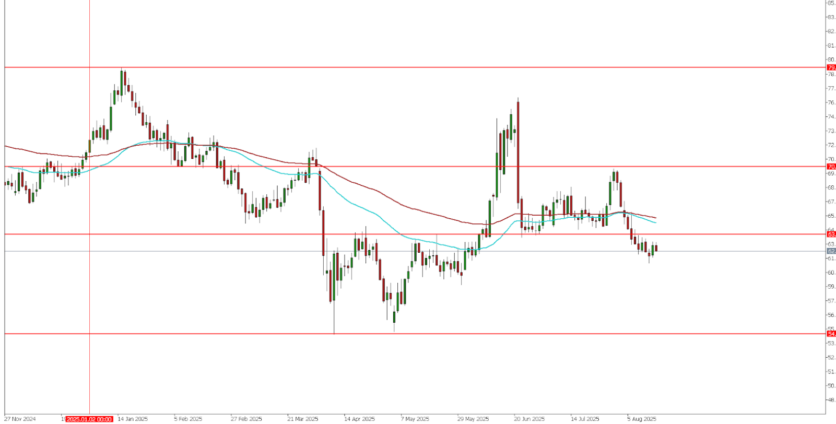
These price projections reflect the anticipated impact of sustained inventory builds and the fundamental oversupply condition. The forecasts suggest that current price levels around $71 per barrel are unsustainable given the underlying supply-demand balance, with significant downward pressure expected to persist into early 2026.
Market structure and trading dynamics
The current market structure exhibits characteristic features of an oversupplied environment, with forward curves likely to reflect contango conditions as near-term prices decline relative to longer-dated contracts. This structure typically incentivizes storage and inventory accumulation, potentially exacerbating the oversupply condition in the near term.
Technical resistance levels around $70–75 per barrel are expected to cap any rallies, while support levels in the $60–65 range may provide temporary price floors. However, if fundamental conditions deteriorate further, prices could test lower support levels in the $50–55 range, particularly if global economic conditions weaken or if supply increases exceed current projections.
Market outlook
The current market environment presents distinct challenges for different market participants. For short-term traders, the expected price volatility within a generally declining trend offers tactical opportunities, though careful risk management becomes essential given the potential for rapid geopolitical-driven price spikes.
Long-term investors may find opportunities in the anticipated price weakness, particularly if prices decline to the $50–55 range while showing signs of demand stabilization. However, the timing of such opportunities remains uncertain, and patience will be required given the extended nature of the current supply-demand imbalance.
Hedging strategies become increasingly important for oil-exposed businesses, with the high uncertainty around geopolitical events suggesting that protective strategies against both upside and downside price movements may be prudent.
Looking toward 2026
The oil market outlook extends beyond 2025, with most forecasting agencies projecting continued price weakness into early 2026. The EIA expects that low oil prices will eventually lead to production cutbacks by both OPEC+ and some non-OPEC producers, which should help moderate inventory builds later in 2026[3]. This suggests that the current oversupply cycle may be self-correcting over time, though the adjustment process is expected to extend well into 2026.
Demand growth projections for 2026 show some divergence among forecasting agencies, with the EIA projecting an acceleration to 1.1 million barrels per day growth, while the IEA maintains a more pessimistic assessment expecting a slowdown in demand growth[1][2]. These differing projections highlight the uncertainty surrounding the global economic recovery and its impact on energy consumption patterns.
The fundamental rebalancing of oil markets is expected to be a gradual process, with the interaction between price-responsive supply adjustments and evolving demand patterns ultimately determining the timing and magnitude of any market recovery. Until this rebalancing occurs, the oil market is likely to remain under pressure, with periodic volatility driven by geopolitical developments providing the primary source of upside risk to an otherwise bearish fundamental outlook.
Discover the latest Headway updates on Telegram, Facebook, and Instagram.