
Case Study: A “Fake Breakout” on XAUUSD (November 2025)


What happened – context & price action
By early November 2025, gold was trading at $3,935. As the month rolled by, macro conditions seemed very supportive for gold: expectations of a rate cut, ongoing global uncertainty, and strong demand from central banks.
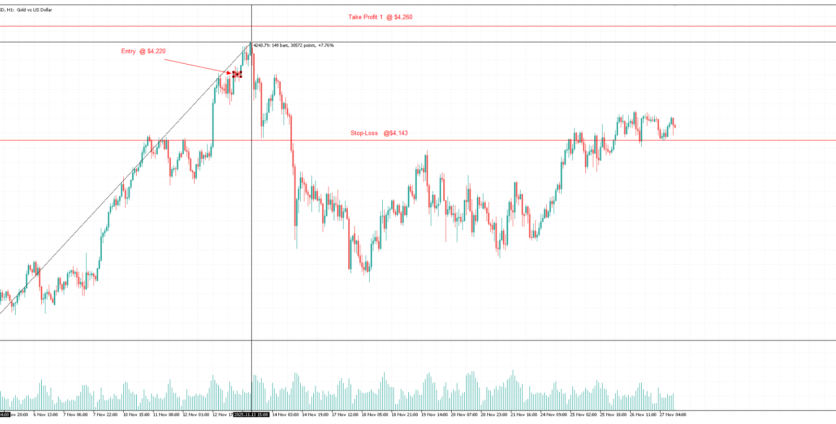
On November 12-13, 2025, gold briefly surged, climbing towards $4,245. The market was optimistic, targeting a retest of that level, assuming the uptrend would hold. However, by November 14, the rally lost steam: the price failed to break above $4,245, and then gold corrected downward and sharply fell to $4,050 and lower.
What the “failed trade” looked like
A trader opened a long position around the rally, expecting continuation above resistance. The setup looked like this:
- Entry: $4,220 (on 13 Nov)
- Target 1: $4,260
- Stop loss: $4,143
This would seem reasonable given momentum, macro backing, and bullish sentiment. But in reality:
- Price did approach the target zone, but failed to break and hold above
- Instead of continuing up, gold reversed - price dropped back below $4,050 within 24h
- The trade closed at a loss, but missed the breakout that was hoped for.
So: a “failed breakout long” - where the bullish expectations met a price rejection at resistance, leading to a swift reversal.
Likely reasons it failed
- Strong resistance zone. The level around $4,245 – 4,250 appeared to have triggered significant profit-taking. The fact that the rally stalled there suggests many participants were watching that zone
- Over optimism. By mid-November 2025, gold had gained almost 8% in a week. When markets price in a lot of bullish expectations, there can be less “fuel” left - making a reversal more likely when doubts creep in (or if some data disappoints)
- Profit-taking/risk-off reaction. Some investors had likely taken profits near recent highs, especially given how fast gold had risen. Once supply overwhelmed demand at that level, the price snapped back.
- Potential liquidity/timing factors. In fast rallies like this, liquidity and sharp reversals often cause volatility. Traders chasing breakouts can get trapped.
What is the lesson out of this
- Don’t blindly trust momentum or hype – even if macro drivers look solid, the resistance zone often attracts the sellers. A breakout only becomes reliable after a clean break and hold.
- Use proper risk management – tight stop loss and realistic targets. Prepare for reversals also. Breakout trades are always riskier than the trend-following ones.
- Wait for confirmation, not just signals. Just touching the target is good, but it needs the second leg (holding supports, constant volumes) for breaking it. Understanding the difference between short-term and structural moves
Unlock smarter trading decisions today – get to know the insights that move the market.


