
VSA Analysis: A Trading Method That Does Not Require Indicators


Volume Spread Analysis (VSA) is a technical analysis method that seeks to decode the intentions of major market players by examining the relationship between volume, price spread, and closing prices. Rooted in the principles of Richard Wyckoff's theories of market behavior, VSA provides traders with a comprehensive framework to understand market trends, accumulation and distribution phases, and the underlying strength or weakness of a financial instrument.
Foundations and Richard Wyckoff’s method
The foundational concept of VSA is that markets move due to the forces of supply and demand, which are largely influenced by institutional investors, or so-called smart money. These market participants possess the resources and expertise to accumulate or distribute positions over time without drawing attention to their actions. By studying the volume in conjunction with price spread, VSA enables traders to detect these activities and align their strategies accordingly.
Richard Wyckoff's market methodology serves as the philosophical backbone of VSA. Wyckoff proposed that markets follow a cyclical pattern of accumulation, mark-up, distribution, and mark-down. Within these phases, price action exhibits telltale characteristics that reveal the footprints of professional money.
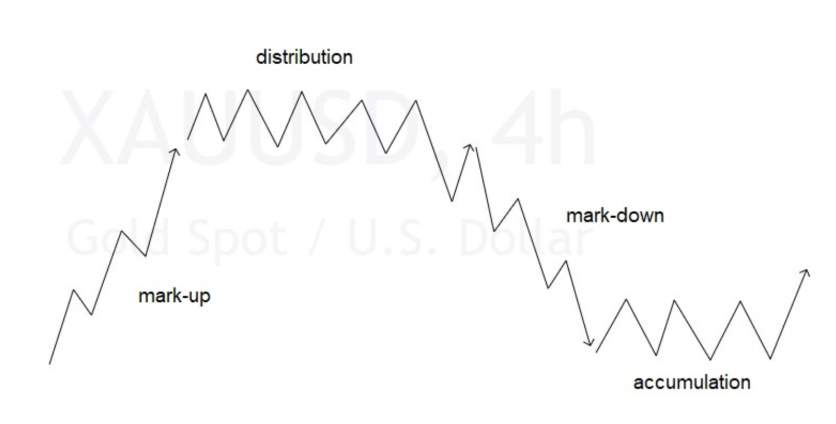
Accumulation occurs when large players stealthily acquire positions, often during periods of relatively low volatility. This phase is marked by increased volume without significant price movement, indicating that supply is being absorbed. As buying interest gains momentum, the market transitions to the markup phase, where prices rise steadily on increasing volume, confirming demand dominance.
Conversely, distribution signifies the gradual selling of holdings by smart money, typically occurring near market tops when public interest is high. Here, price action often experiences wide spreads and high volume, reflecting the transfer of assets from strong to weak hands. The subsequent markdown phase sees prices decline as supply outweighs demand, with decreased volume confirming the lack of buying interest.
Three Wyckoff laws to predict the market
A key principle of VSA is the interplay between volume and spread. A wide price spread accompanied by high volume generally signals professional involvement, whereas a narrow spread with high volume could indicate absorption or hidden accumulation.
Similarly, low volume with a wide spread may suggest a lack of significant interest or market exhaustion. The position of the closing price within the spread is also crucial; for example, a high close on increasing volume suggests bullish strength, whereas a low close signals selling pressure.
1. Supply vs demand law
The core analytical process within VSA involves recognizing specific bar patterns and their contextual significance.
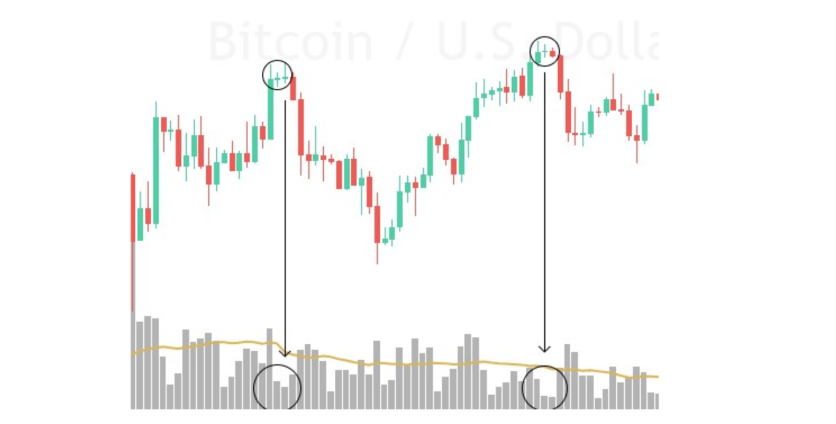
For instance, "no-demand" bars, characterized by small bodies and low volume during uptrends, indicate that institutional buying does not support upward movement. Conversely, "no-supply" candlesticks appearing in downtrends with low volume and narrow spreads suggest a lack of selling interest, hinting at a potential reversal.
2. Effort vs result law
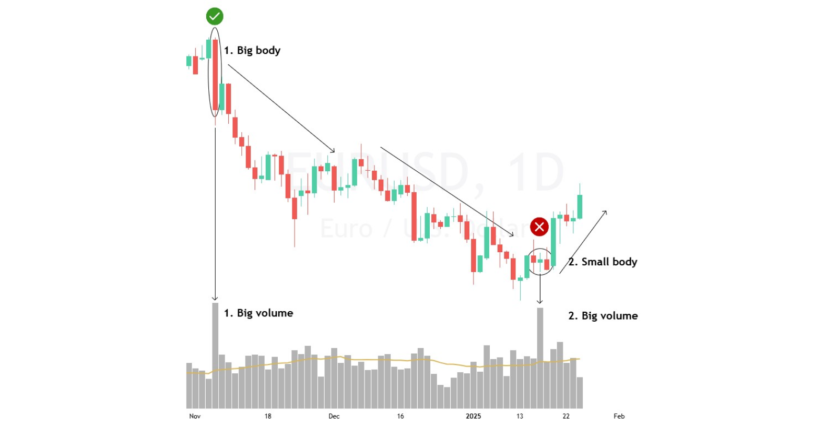
The law of effort versus result suggests that market moves should be proportional to the effort exerted, reflected in volume. If you have a combination of small body/small volume or big body/big volume, the candlestick is valid and shows strength in the direction of its closing price.
If high effort (volume) leads to little price movement (result), it should be viewed as an “anomaly”, signaling possible reversals. Conversely, if a significant price move occurs on relatively low volume, it is also an “anomaly”, which may suggest a lack of interest or weak participation, making the move unsustainable.
3. Cause vs effect law
Another critical principle is the law of cause and effect, which posits that significant market moves require a preparatory phase. The longer the accumulation or distribution period, the greater the resulting trend is likely to be.
Traders use this concept to assess how long the market has been preparing for a move and whether the resulting breakout or breakdown will likely be sustained. It helps to provide a rough understanding of profit potential for market moves.
Moreover, it allows traders to decide whether and where to join a starting trend by market or through limit orders.
VSA applied to real life
The practical application of VSA requires traders to focus on key elements such as climatic volume spikes, testing for support or resistance levels, and identifying stopping volume that indicates the end of a trend.
For example, a sharp increase in volume after a prolonged downtrend, accompanied by a wide wick and a close in the upper portion of a range, suggests professional buying and a potential reversal. Likewise, signs of distribution can be spotted through persistent high-volume up-bars that fail to advance prices meaningfully, indicating absorption by selling pressure.
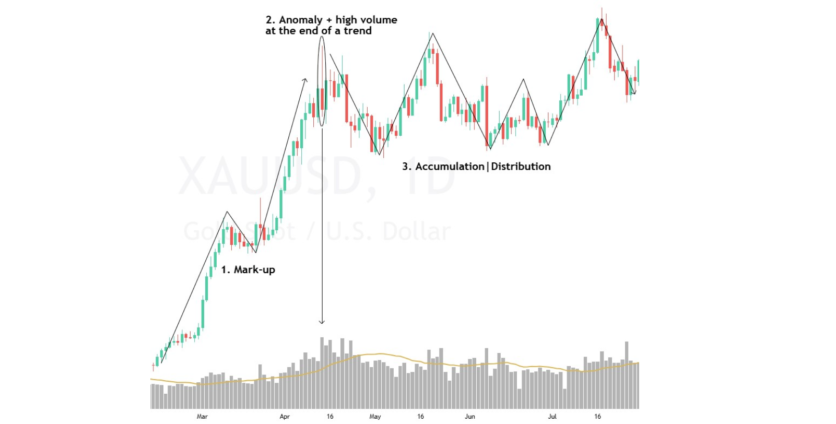
The ability to interpret VSA signals is significantly enhanced by integrating market context. This involves recognizing the broader market phase and correlating it with specific volume and price behavior patterns.
A trader well-versed in Wyckoff's methodology and VSA principles can identify when institutions are positioning themselves ahead of major moves, thus gaining a crucial edge in market participation.
Conclusion
Volume Spread Analysis offers a powerful lens through which traders can decipher the true forces driving market behavior. By applying Wyckoff's timeless principles and carefully analyzing the interplay of volume, price spread, and closing positions, traders can uncover hidden market dynamics and align their strategies with the movements of professional money.
Mastery of VSA requires diligent practice, a keen eye for detail, and an understanding of the nuanced relationship between supply and demand that ultimately shapes market trends.
Discover the latest Headway updates on Telegram, Facebook, and Instagram.


